The last two years have fundamentally shifted the way customers research, compare, and purchase products and services – and the communications industry is no exception. As individual consumers and business buyers increasingly turn to AI systems for comparisons and recommendations, brands need to understand how they are showing up in these conversations. And that shift is only expected to accelerate, with more than one-third of U.S. consumers are expected to use generative AI for shopping by 2030 [1].
AI is already influencing how consumers make purchasing decisions. Among users who report using gen-AI weekly, 44% say they prefer using it to compare products, 38% to compare prices, and 34% to get product recommendations [2]. In other words, AI is becoming an increasingly important part of the consideration process – well before a customer is ready to make a purchase.
That raises an important question for brands:
When someone asks AI about your brand or providers like you, are you in the answer – and do you like what it says?
Most brands don’t know the answer. Not because they aren’t thinking about it, but because visibility in AI-driven search is harder to measure than a ranking on a traditional search results page. AI responses can vary depending on the model, the phrasing, and the context of the query.
But the initial assessment doesn’t have to be complicated. It starts with asking the AI the same questions your prospects are already asking.
Ask the Questions Your Customers Ask
The most direct way to understand your brand’s standing in AI is to prompt the models directly, then read the results the way a prospect would.
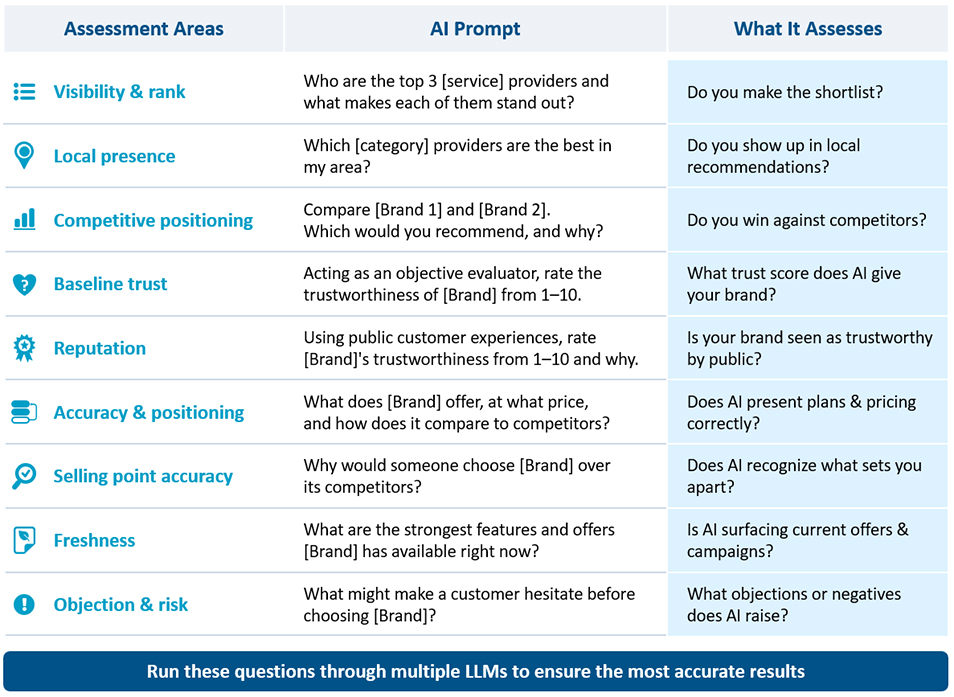
We’ve developed a structured set of prompts covering the areas that shape purchasing decisions across both consumer and business markets. A few of the key areas the prompts address include:
- Visibility and rank: Who are the top providers for this service, and what makes each stand out? Do you make the shortlist?
- Competitive positioning: Asked to compare you against a named competitor, which does the AI recommend, and why?
- Accuracy and positioning: Does the AI describe your plans, pricing, and offers correctly, and against the right competitors?
- Objection and risk: Asked what might make a customer hesitate, what negatives does the AI raise?
These questions can be adapted to different customer segments, products, and stages of the buying journey. For example, a residential broadband customer may ask which internet provider offers the best value in their area, while an enterprise buyer may ask which network provider is best equipped to support a multi-location business.
Run these prompts through more than one AI model. Answers vary across systems, and a single tool provides only one, potentially misleading, view of your brand’s visibility.
Turn Initial Findings into a Measurable Baseline
Running these prompts provides valuable qualitative insights into how AI represents your brand. But understanding what AI says about you today is only the starting point. The next step is establishing a quantitative baseline that allows you to measure performance and track improvement over time.
That requires a more structured approach, including building a representative prompt library, establishing visibility benchmarks, evaluating accuracy and sentiment, and setting up dashboards to monitor performance across AI models over time.
These insights can help brands understand not just where they stand today, but how their visibility compares to competitors and whether their AI search optimization efforts are making a measurable difference.
Use the Results to Prioritize Your AI Search Strategy
Once you have a baseline, the next step is turning those findings into action.
If your brand is consistently missing from relevant recommendations, incorrectly described, or losing head-to-head comparisons, those findings can help identify where to focus first.
Determining which actions will have the greatest impact is the more difficult part. Depending on the findings, opportunities may include improving website content, clarifying product and service information, strengthening third-party references, or addressing gaps in how your brand is represented online.
Combined with a clear AI search strategy and ongoing performance measurement, these improvements can help strengthen your brand’s visibility and credibility in AI-generated results.
The goal isn’t simply to appear in AI-generated answers. It’s to ensure your brand is accurately represented, competitively positioned, and visible when prospective customers are making decisions.
How Cartesian Helps
Cartesian, a Bounteous company, helps communications providers and other brands understand how they appear across AI systems and translate those insights into measurable improvements.
Combining Cartesian’s deep industry expertise with Bounteous’ broader AI and digital experience capabilities, we bring both the tooling to measure visibility across models – including access to leading AI visibility platforms – and the strategy to act on what it shows. From developing prompt libraries and establishing performance baselines to ongoing monitoring and optimization, we help brands turn AI visibility insights into meaningful action.